

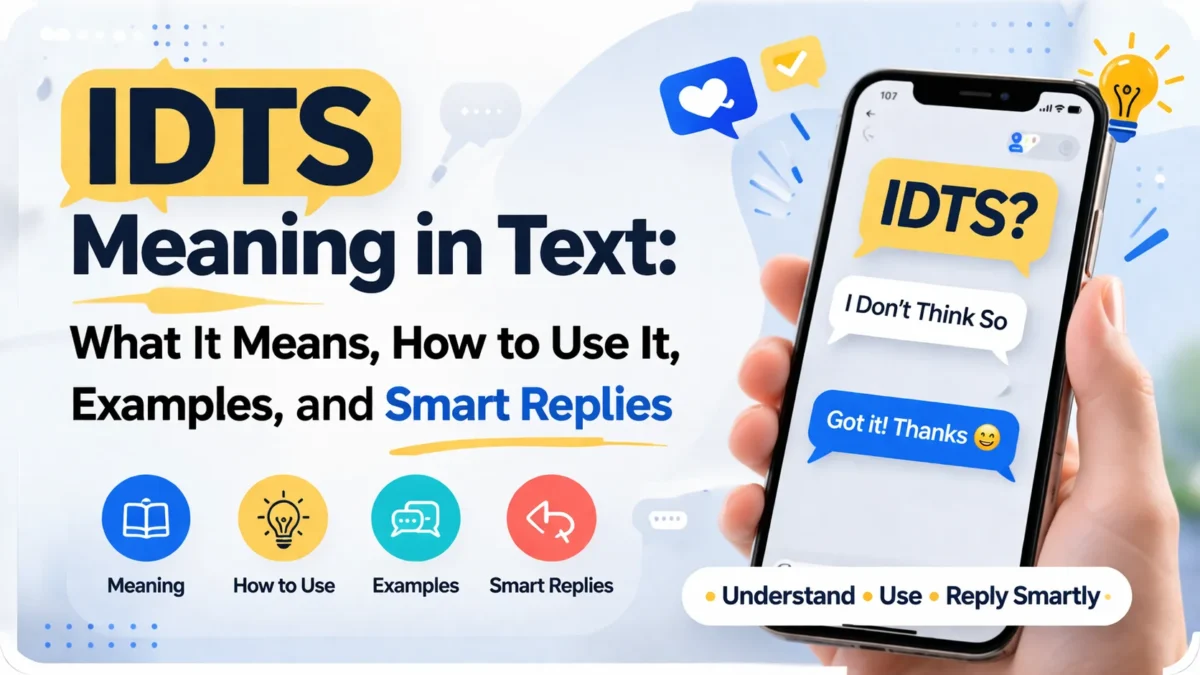
You’ve probably seen “IDTS” pop up in a message and paused for a second. It looks simple. Still, the meaning can shift depending on tone. Curious about IDTS Meaning in Text? Learn its definition, real examples, and how to use it in chats to stay smart and updated online!
IDTS stands for “I Don’t Think So.”
That’s the short version. But here’s the real insight.
People rarely use IDTS as a blunt “no.” Instead, they lean on it as a soft refusal, a hint of doubt, or even playful sarcasm. Tone changes everything.
Quick Example
- “Are you coming to the party?”
- “IDTS”
At face value, that sounds like a no. However, depending on context, it could mean:
- “Probably not”
- “I’m unsure”
- “Convince me”
- “Not a chance 😂”
That’s why understanding IDTS meaning in text goes beyond memorizing words. You need to read the vibe.
What IDTS Really Implies (Context Changes Everything)
Here’s where most guides fall short. They give you a definition. They don’t explain how it feels in real conversations.
Think of IDTS like a chameleon. It adapts to tone, relationship, and situation.
Direct Refusal (The Soft “No”)
Sometimes, IDTS means exactly what it says. Still, it softens the blow.
Instead of saying:
- “No”
- “I won’t”
You say:
- “IDTS”
It feels lighter. Less confrontational.
Example
- “Can you help me move tomorrow?”
- “IDTS, I’m busy.”
Notice the difference. It avoids sounding harsh.
Uncertainty or Doubt
This is one of the most common uses in 2026.
People use IDTS when they:
- Aren’t fully sure
- Want to avoid commitment
- Need more time to decide
Example
- “Will it rain today?”
- “IDTS”
Here, it doesn’t mean “no.” It means “I doubt it.”
Playful or Sarcastic Tone
Now it gets interesting.
Among friends, IDTS often carries a teasing or joking vibe. It can even mean the opposite of what it says.
Example
- “You’re going to beat me in this game?”
- “IDTS 😏”
That’s not serious. It’s playful confidence.
Passive-Aggressive or Dismissive Use
Used wrong, IDTS can feel cold.
Short replies without context sometimes signal:
- Disinterest
- Annoyance
- Emotional distance
Example
- “Do you even care?”
- “IDTS”
That hits differently. It feels blunt.
Where You’ll See IDTS Most Often in 2026
Language evolves fast. Slang moves even faster.
Right now, IDTS thrives in fast-paced digital spaces where speed matters more than grammar.
Text Messaging Apps
- iMessage
- Messenger
People use IDTS because it’s quick. One tap beats typing a full sentence.
Social Media Platforms
- TikTok comments
- Instagram DMs
- Snapchat chats
Short replies dominate these platforms. IDTS fits perfectly.
Gaming and Discord Chats
Gamers prefer fast, efficient communication.
Instead of typing:
- “I don’t think that strategy will work”
They say:
- “IDTS”
Meme Culture
IDTS shows up in memes as:
- Reaction text
- Sarcastic captions
- Humor-based replies
Example meme idea:
“Me thinking I’ll wake up early tomorrow”
IDTS
How to Use IDTS Correctly (Without Sounding Rude)
Using IDTS the wrong way can backfire. Tone doesn’t always translate well in text.
Let’s break it down so you don’t accidentally sound cold.
Use IDTS in Casual Conversations
IDTS works best with:
- Friends
- Family
- Close coworkers
Example
- “Let’s go out tonight”
- “IDTS, I’m tired”
That feels natural. No awkwardness.
Soften Your Tone With Emojis or Follow-Ups
Tone matters more than words.
You can instantly make IDTS sound friendly.
Examples
- “IDTS 😂”
- “IDTS lol maybe next time”
- “IDTS but I wish I could”
These add warmth.
Avoid IDTS in Professional Settings
This is where many people slip.
In work emails or formal chats, IDTS feels:
- Too casual
- Slightly dismissive
Better Alternatives
- “I don’t believe that will work”
- “I’m not available at that time”
Don’t Use It in Serious Conversations
If emotions run high, avoid slang.
Example
Bad:
- “Do you care about this?”
- “IDTS”
Better:
- “I don’t think that’s accurate, let’s talk about it”
Real-Life Examples of IDTS in Conversations
Let’s make this real. You’ll understand faster when you see it in action.
Friendly Chat Example
Conversation:
- A: “Movie tonight?”
- B: “IDTS, I’ve got work 😩”
👉 Meaning: Soft no
Flirty Conversation Example
Conversation:
- A: “You’re not thinking about me right now”
- B: “IDTS 😉”
👉 Meaning: Playful tease
Group Chat Example
Conversation:
- A: “We’re all waking up at 6 AM tomorrow”
- B: “IDTS 😂”
👉 Meaning: Not happening
Awkward or Cold Example
Conversation:
- A: “Are you interested in this?”
- B: “IDTS”
👉 Meaning: Blunt rejection
Read More: OTW Meaning in Text (2026): What OTW Really Means in Chat
How to Respond to IDTS (Smart Replies That Fit the Situation)
This is where you gain an edge. Most people don’t know how to reply properly.
If It Sounds Playful
Keep the energy going.
Replies
- “We’ll see about that 😄”
- “Challenge accepted”
- “Don’t be so sure”
If It’s a Soft No
Respect it. Don’t push too hard.
Replies
- “No worries!”
- “Maybe next time”
- “All good, I understand”
If It Feels Dismissive
Clarify calmly.
Replies
- “Got it, just checking”
- “Alright, thanks for being honest”
- “No problem”
If You Want to Persuade
Be light, not pushy.
Replies
- “Come on, it’ll be fun 😄”
- “Just for a little while?”
- “You might change your mind”
IDTS vs Similar Slang (Key Differences Explained)
Many people confuse IDTS with other abbreviations. That leads to misunderstandings.
Here’s a clear breakdown.
Comparison Table
| Slang | Full Form | Tone | What It Really Means |
| IDTS | I Don’t Think So | Casual / soft | Likely no or doubt |
| IDC | I Don’t Care | Cold / dismissive | No interest |
| IDK | I Don’t Know | Neutral | Uncertainty |
| IMO | In My Opinion | Neutral | Personal view |
| NVM | Never Mind | Withdrawn | Dropping topic |
Key Insight
- IDTS = softer than “no”
- IDC = harsher than IDTS
- IDK = unsure, not rejecting
Small differences. Big impact.
Why People Use IDTS Instead of Saying “No”
This isn’t random. There’s psychology behind it.
Avoiding Conflict
People don’t like confrontation.
IDTS helps them:
- Say no indirectly
- Keep things polite
Maintaining Social Harmony
In group settings, tone matters.
IDTS keeps things:
- Light
- Friendly
- Non-aggressive
Speed and Convenience
Typing matters.
Compare:
- “I don’t think so” → 16 characters
- “IDTS” → 4 characters
Faster. Easier.
Fits Digital Culture
Modern communication favors:
- Short replies
- Quick reactions
- Minimal effort
IDTS checks all boxes.
Tone Breakdown: How IDTS Feels in Different Contexts
Tone shifts depending on situation.
Context Table
| Context | Tone | Interpretation |
| Friends | Playful | Light rejection |
| Dating | Flirty | Teasing or uncertain |
| Work | Unprofessional | Avoid |
| Arguments | Dismissive | Risky |
| Family | Casual | Neutral |
Important Insight
Same word. Different meaning.
That’s why context always wins over dictionary definitions.
Common Mistakes People Make With IDTS
Even simple slang can go wrong.
Using It in Formal Situations
Emails. Job chats. Professional messages.
It feels lazy.
Misreading Tone
Without emojis or context, IDTS can feel:
- Cold
- Distant
Overusing Slang
Too much slang reduces clarity.
Balance matters.
Sounding Rude Without Intention
Short replies can feel harsh.
Add context when needed.
Should You Use IDTS in 2026? (Modern Usage Insight)
Short answer: Yes, but smartly.
Still Relevant
IDTS remains popular across:
- Gen Z
- Millennials
- Online communities
Best Use Cases
- Casual texting
- Friendly chats
- Light conversations
When to Avoid
- Professional communication
- Serious discussions
- Emotional conversations
Trend Insight
People now prefer:
- Slightly more expressive replies
- Emojis or tone indicators
So instead of just:
- “IDTS”
You’ll often see:
- “IDTS lol”
- “IDTS 😅”
Alternatives to IDTS (Better Options for Different Situations)
Sometimes, you need variety.
Polite Alternatives
- “I don’t think I can”
- “Probably not”
- “I’m not sure about that”
Casual Alternatives
- “Not really”
- “Nah”
- “I doubt it”
Playful Alternatives
- “Yeah… no 😄”
- “Nice try”
- “Keep dreaming”
Mini Cheat Sheet (Fast Recap)
- IDTS = I Don’t Think So
- Used for: soft no, doubt, teasing
- Best for: casual chats
- Avoid in: formal situations
- Tone depends on: context + relationship
Case Study: How One Message Changes Everything
Let’s break this down.
Scenario 1: Plain IDTS
- “Want to hang out?”
- “IDTS”
👉 Feels cold
Scenario 2: IDTS with Context
- “Want to hang out?”
- “IDTS, I’m exhausted today 😅”
👉 Feels natural
Scenario 3: Playful IDTS
- “You’re losing this game”
- “IDTS 😏”
👉 Feels confident and fun
Lesson
Words matter. Tone matters more.
Expert Insight: Why Short Replies Feel Stronger
“The shorter the message, the stronger the emotional interpretation.”
Short texts leave room for interpretation.
That’s why IDTS can feel:
- Friendly
- Cold
- Funny
All at once.

Pun enthusiast, wordplay wizard, and the mastermind behind Funnnypuns.com. David turns everyday language into laugh-out-loud moments—one pun at a time!




Leave a Comment