

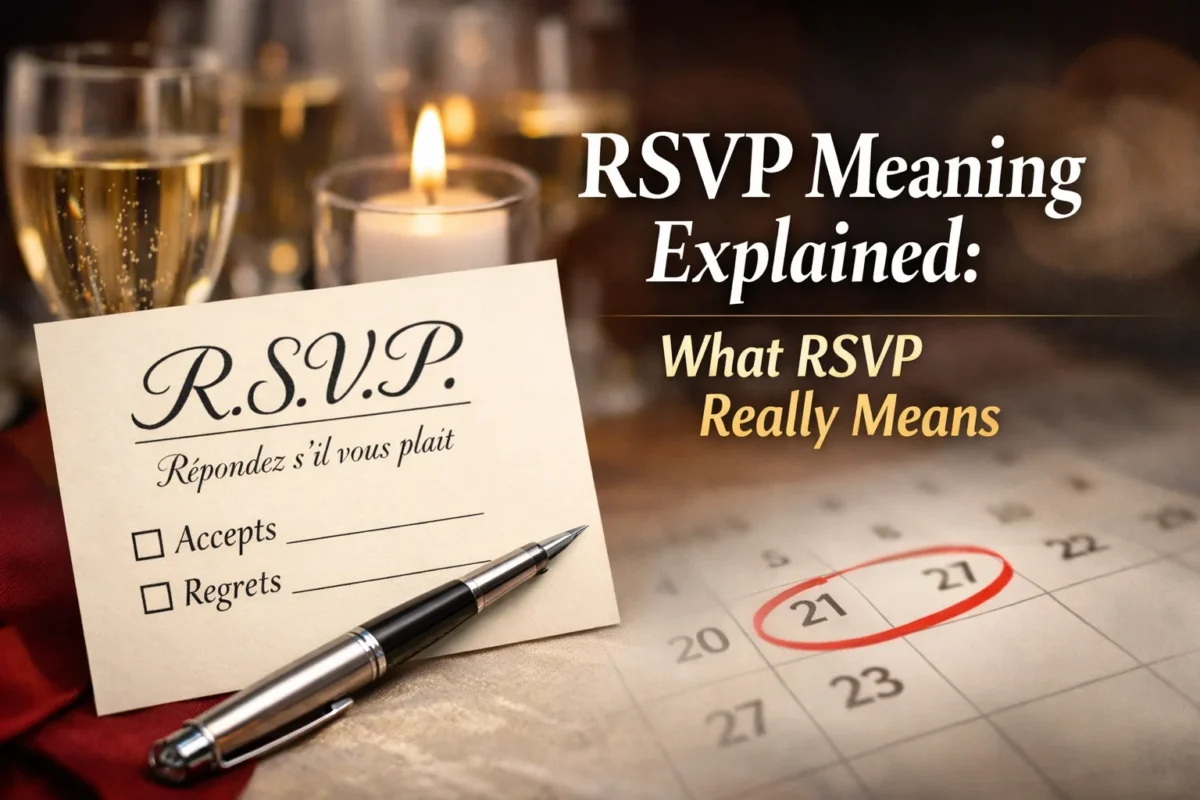
You’ve probably seen RSVP on wedding cards, party invites, or event emails. Most people glance at it and think, “Yeah, I’ll reply later.” Then later never comes. That tiny abbreviation causes more confusion than it should. Here’s the truth: RSVP isn’t just a polite suggestion. It’s a request that directly affects planning, money, food, space, and sometimes even relationships.
In this guide, you’ll learn exactly what RSVP meaning explained, why it matters, and how to respond the right way without overthinking it. Let’s break it down in a simple, practical way you can actually use.
RSVP Meaning Explained: What RSVP Actually Stands For
RSVP comes from the French phrase:
“Répondez s’il vous plaît”
In plain English, it means:
“Please respond.”
That’s it. Simple, but powerful.
However, most people misunderstand it. They assume RSVP means “reply if you want to come.” That’s not correct.
It actually means:
- The host needs a clear yes or no
- Your response is expected, not optional
- Your answer helps finalize event planning
Why French is used in RSVP
RSVP comes from French social etiquette traditions in the 18th–19th century. At that time, French culture influenced formal etiquette across Europe and later America.
Even today, event language keeps French terms like:
- RSVP
- Cuisine
- À la carte
They sound formal, and that’s exactly why they stuck.
RSVP Meaning Explained: Why Hosts Actually Care About Your Response
If you think RSVP is just a formality, think again.
For hosts, your response affects real decisions like:
- How much food to prepare
- How many chairs and tables to set up
- Venue size and cost
- Seating arrangements
- Budget per guest
Imagine planning a wedding for 200 people. Now imagine 50 guests show up without responding. That chaos turns into wasted money or missing resources.
Real impact example
Let’s say food costs $15 per plate.
- 100 confirmed guests = $1,500 budget
- 150 actual guests show up = $750 unexpected cost
That’s why RSVP is not optional in serious events.
It protects the host from guessing games.
RSVP Meaning Explained: Where You’ll See It Most Often
RSVP shows up in many situations, not just formal invitations.
Common places you’ll see RSVP requests
- Weddings and engagement ceremonies
- Corporate events and seminars
- Birthday parties
- Baby showers
- Graduation events
- Charity dinners
- Online Zoom or webinar invites
- WhatsApp or social media event groups
Modern RSVP formats
Today, RSVP doesn’t always appear on paper cards. You might see:
- “Please RSVP by March 10”
- “Kindly respond”
- “Confirm attendance”
- A clickable “Yes / No” button
The format changed, but the meaning stayed the same.
RSVP Meaning Explained: How to Respond the Right Way
Now comes the most important part.
Responding to RSVP seems simple, but small mistakes can create awkward situations.
Let’s break it down clearly.
RSVP Meaning Explained: How to Say Yes Properly
When you accept an invitation, don’t just say “Yes.”
A proper RSVP response includes:
- Confirmation
- Number of guests (if allowed)
- Appreciation message
Example of a good RSVP yes response
Formal:
“Thank you for the invitation. I will attend the event and look forward to it.”
Casual:
“Yes, I’ll be there! Excited to join.”
Pro tip
If the invitation allows plus-one guests, always confirm:
- Whether you’re bringing someone
- Their name if required
It avoids confusion at the entrance.
RSVP Meaning Explained: How to Politely Say No
Declining an invite doesn’t make you rude. Ignoring it does.
A proper “no” response should be:
- Clear
- Polite
- Short
Example RSVP decline messages
Formal:
“Thank you for the invitation. Unfortunately, I won’t be able to attend.”
Friendly:
“I really appreciate the invite, but I can’t make it this time.”
Why this matters
Hosts don’t take “no” personally. They just need clarity.
A clear decline helps them:
- Adjust seating
- Finalize food
- Invite someone else if needed
RSVP Meaning Explained: The Problem With “Maybe” Responses
“Maybe” sounds harmless, but it creates problems.
Hosts hate uncertainty because:
- They can’t finalize numbers
- It delays planning
- It increases costs risk
When “maybe” is acceptable
Only use it when:
- You’re waiting on travel confirmation
- You have a serious scheduling conflict
- You will confirm within a short time (24–48 hours)
Better alternative
Instead of “maybe,” say:
“I’m checking my schedule and will confirm by tomorrow.”
That keeps things respectful and clear.
RSVP Meaning Explained: Etiquette Rules Most People Ignore
RSVP etiquette is simple, but many people still mess it up.
Here are rules you should actually follow:
Basic RSVP etiquette rules
- Respond as soon as possible
- Never ignore an invitation
- Don’t say yes unless you plan to attend
- Inform the host if your plans change
- Respect RSVP deadlines
- Don’t bring extra guests without permission
Golden rule
If you wouldn’t want someone doing it to you, don’t do it as a guest.
RSVP Meaning Explained: What RSVP Deadlines Really Mean
When an invitation says “RSVP by May 10,” it’s not a suggestion.
It means:
- The host needs final numbers by that date
- Planning decisions happen immediately after
- Late responses may not be accepted
Why deadlines matter
Hosts usually finalize:
- Catering orders
- Seating charts
- Venue setup
Simple rule to follow
Respond within:
- 24–48 hours for formal events
- Same day for close friends or casual invites
Read More: Habibi Meaning Slang: What “Habibi” Really Means in Text
RSVP Meaning Explained: Digital vs Traditional RSVP
RSVP has evolved a lot.
Let’s compare both formats.
RSVP comparison table
| Feature | Traditional RSVP | Digital RSVP |
| Speed | Slower | Instant |
| Tracking | Manual | Automated |
| Error rate | Higher | Lower |
| Convenience | Moderate | High |
| Cost | Printing required | Usually free |
Digital RSVP advantages
- Instant confirmation
- Easy updates
- Automatic reminders
- Less chance of losing invite
Traditional RSVP charm
Still used for:
- Weddings
- Formal invitations
- Cultural events
It feels more personal and elegant.
RSVP Meaning Explained: Common Mistakes People Make
Even simple RSVP responses go wrong more often than you think.
Frequent RSVP mistakes
- Ignoring the invitation completely
- Replying after the deadline
- Changing answers multiple times
- Showing up with uninvited guests
- Misreading event details
Real-world mistake example
A guest confirms attendance for a wedding but shows up with two extra friends.
Result:
- Seating issue
- Food shortage
- Stress for the host
Small mistake. Big impact.
RSVP Meaning Explained: Copy-Paste Message Templates
Here are ready-to-use responses.
Yes templates
“Thank you for inviting me. I will attend and look forward to it.”
“Yes, I’ll be there. Excited to join the event.”
No templates
“Thank you for the invitation. I won’t be able to attend.”
“I appreciate the invite, but I have a prior commitment.”
Maybe (use carefully)
“I’m checking my schedule and will confirm shortly.”
RSVP Meaning Explained: Cultural Differences You Should Know
RSVP expectations vary across cultures.
Western countries (USA, UK, Europe)
- Strict RSVP expectations
- Late responses seen as disrespectful
- Planning depends heavily on guest confirmation
South Asian cultures
- More flexible approach
- Guests sometimes attend without formal RSVP
- Hosts often prepare extra capacity
Middle Eastern gatherings
- Hospitality culture often expects extra guests
- RSVP still helpful but less strict
Key takeaway
Always follow the host’s instructions, not assumptions.
RSVP Meaning Explained: Case Studies From Real Life Events
Let’s look at how RSVP affects real situations.
Case Study 1: Wedding Planning Disaster Avoided
A couple planned a wedding for 120 guests.
They sent RSVPs with a strict deadline.
Result:
- 118 confirmed
- 2 declined
- No surprises
Because everyone responded on time:
- Catering matched exactly
- Seating stayed organized
- No food waste
Lesson: RSVP saves money and stress.
Case Study 2: Corporate Event Chaos
A company hosted a seminar for 80 attendees.
Only 50 responded to RSVP.
But 70 showed up.
Problems:
- Not enough seats
- Limited food
- Poor experience
Lesson: Ignoring RSVP creates operational failure.
Case Study 3: Birthday Party Success Through Clear RSVP
A host requested RSVP with guest count.
Guests responded properly:
- Accurate headcount
- Perfect food planning
- Smooth event flow
Lesson: Clear communication improves experience for everyone.
RSVP Meaning Explained: Expert Tips to Handle It Like a Pro
If you want to stand out socially, follow these tips:
- Respond within 24 hours
- Treat RSVP like a commitment
- Always double-check your availability
- Keep responses short and clear
- Set reminders for deadlines
- Respect the host’s planning effort
Think of RSVP like this
It’s not just a reply.
It’s a promise.
FAQs
What does RSVP stand for in simple terms?
RSVP stands for the French phrase “Répondez s’il vous plaît.” In simple English, it means “Please respond.” It asks you to confirm whether you will attend an event or not.
Is RSVP optional or mandatory?
RSVP is technically a request, but in real-life etiquette it is treated as mandatory, especially for formal events like weddings, corporate meetings, or private dinners.
What happens if you don’t respond to an RSVP?
If you ignore an RSVP, the host may assume you are not coming. However, this creates planning problems like wasted food, poor seating arrangements, or last-minute confusion.
Can I change my RSVP after submitting it?
Yes, you can—but only if you inform the host as early as possible. Changing your RSVP last minute can create stress and disrupt event planning.
Why do hosts insist on RSVP responses?
Hosts need RSVPs to plan:
- Food and catering
- Seating arrangements
- Budget control
- Venue space
Without RSVPs, events become unpredictable and expensive.
What is the proper way to RSVP yes?
A good RSVP yes response is:
- Clear
- Polite
- Confident
Example:
“Thank you for the invitation. I will attend the event and look forward to it.”
What is the proper way to RSVP no?
You should politely decline without over-explaining.
Example:“Thank you for the invitation. Unfortunately, I won’t be able to attend.”
Is it rude to say “maybe” on RSVP?
Yes, in most cases. “Maybe” makes planning difficult. If you are unsure, it’s better to give a timeline like:“I will confirm within 24 hours.”
What does RSVP by a date mean?
It means you must respond before that deadline. After that date, the host finalizes arrangements and may not accept late responses.
Where do I usually see RSVP requests?
You’ll see RSVP requests in:
- Weddings and receptions
- Birthday parties
- Corporate events
- Baby showers
- Online event invitations (email, WhatsApp, apps)
Conclusion:
RSVP is more than just a word on an invitation. It is a basic part of social respect and event planning. When you respond to an RSVP properly, you make life easier for the host. You help them prepare food, seating, and space without guessing. That small action also shows reliability and good manners.
The biggest takeaway is simple: don’t ignore it, don’t delay it, and don’t treat it casually. Whether you say yes or no, respond clearly and on time. That’s what makes RSVP work the way it should—smooth, respectful, and stress-free for everyone involved.

Emma Brooke is the witty mind behind Funnnypuns.com, bringing you clever puns, hilarious jokes, and lighthearted humor to brighten your day.
![120+ Best Valentines Day Heart Puns [2026 Trending & Top Picks]](https://funnnypuns.com/wp-content/uploads/2025/12/best-valentines-day-heart-puns-440x248.webp)
![120+ Best Valentines Day Heart Puns [2026 Trending & Top Picks]](https://funnnypuns.com/wp-content/uploads/2025/12/best-valentines-day-heart-puns-320x180.webp)


Leave a Comment