

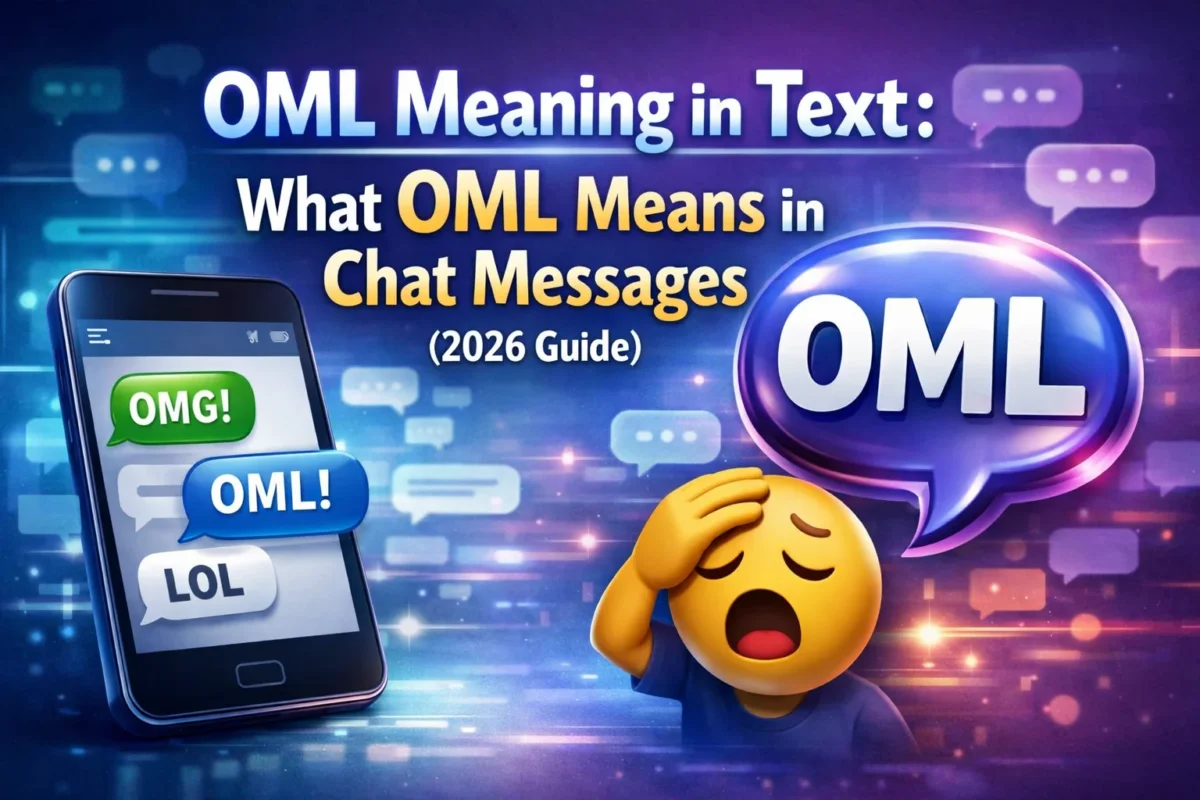
If you’ve ever seen someone type “OML” in a message and paused for a second, you’re not alone. It looks short, casual, and slightly mysterious at first glance. Yet it pops up everywhere—from TikTok comments to WhatsApp chats to gaming reactions.Here’s the truth: OML is one of those slang terms that carries strong emotion in just three letters.
And once you understand it, you’ll start noticing it everywhere. In this guide, you’ll learn exactly what OML meaning in text really is, how people use it in real conversations, and why it’s become such a big part of internet language. We’ll also break down real examples, emotional tone, mistakes people make, and even how it compares to similar slang like OMG.
OML Meaning in Text Explained (Simple Definition and Real Usage)
At its core, OML stands for “Oh My Lord.”
It’s an emotional expression people use when they react strongly to something surprising, shocking, funny, or even frustrating.
Think of it as a quick verbal “explosion” in text form.
People don’t use it to describe facts. Instead, they use it to show feelings in the moment.
What OML really means in everyday chats
- Surprise: “OML I didn’t expect that!”
- Shock: “OML that ending was wild”
- Frustration: “OML why is this happening again”
- Excitement: “OML this is amazing”
Even though the literal meaning is religious in origin, most people today use it in a completely casual way.
It works more like a reaction sound than a serious phrase.
For example:
- “OML you scared me!”
- “OML that test was harder than I thought”
Short. Fast. Emotional.
That’s the entire purpose.
Why People Use OML Instead of Writing Full Sentences
Here’s something interesting about internet language: people don’t just want to communicate. They want to react instantly.
OML fits that need perfectly.
Instead of typing:
“Oh my gosh, I can’t believe what just happened”
Someone just types:
“OML”
It saves time and still shows emotion.
Why OML became popular online
- Faster typing in chats
- Strong emotional expression in fewer characters
- Fits memes and short-form content
- Feels natural in casual conversation
You’ll mostly see it in informal spaces where speed matters more than grammar.
Think of it like a facial expression—but in text form.
How OML Is Actually Used in Real Conversations
OML doesn’t follow strict grammar rules. That’s part of what makes it feel human.
People use it in different positions depending on emotion and style.
At the beginning of a sentence
This is the most common form.
- “OML I just saw the funniest video”
- “OML that scared me so bad”
It sets the emotional tone right away.
As a standalone reaction
Sometimes, it stands alone like a reaction emoji.
- Friend: “I failed the exam”
- You: “OML”
Short. Direct. Emotional.
At the end of a sentence
Less common but still used.
- “That was crazy OML”
- “I can’t believe it OML”
It adds emotional emphasis after the thought.
Emotional Tone Behind OML (What It Really Conveys)
OML is flexible. Its meaning shifts depending on context.
That’s what makes it powerful.
Main emotions behind OML
Shock
Used when something unexpected happens.
- “OML I didn’t see that coming”
Excitement
Used for hype moments.
- “OML this song is fire”
Frustration
Used when something goes wrong repeatedly.
- “OML my internet is so slow again”
Amusement
Used when something is funny or ridiculous.
- “OML that video had me crying”
Important insight
OML doesn’t have a fixed emotional value.
Instead, the situation decides the emotion, not the word itself.
That’s why tone in texting matters so much.
OML vs OMG vs OMFG (Clear Breakdown You Can Actually Use)
These three expressions look similar, but they don’t hit the same emotional level.
Here’s a clean breakdown:
| Acronym | Full Form | Emotional Strength | Tone | Common Use |
| OML | Oh My Lord | Mild to medium | Casual, softer | Everyday reactions |
| OMG | Oh My God | Medium | Neutral, universal | General surprise |
| OMFG | Oh My F***ing God | Strong | Intense, emotional | Extreme reactions |
Simple way to remember the difference
- OML = soft reaction
- OMG = normal reaction
- OMFG = intense reaction
Example comparison
Same situation, different reactions:
- OML: “OML that’s crazy”
- OMG: “OMG that’s crazy”
- OMFG: “OMFG that’s insane”
The meaning stays similar, but the emotional volume changes.
Where You’ll See OML Most Often in 2026
OML isn’t limited to one platform. It spreads across the entire internet.
Social media platforms
- TikTok comments
- Instagram captions
- YouTube replies
- Facebook reactions
Example:
- “OML this trend is wild 😂”
Messaging apps
- WhatsApp chats
- Snapchat conversations
- Messenger threads
Example:
- “OML I forgot my assignment”
Gaming chats
Gamers use OML during intense moments.
- “OML clutch play!”
- “OML I got sniped again”
Meme culture
OML often appears in reaction memes where emotion matters more than structure.
Common Misunderstandings About OML
Even though OML is simple, people still misunderstand it.
Let’s clear that up.
Misunderstanding 1: It has only one meaning
Some people think OML always means surprise. That’s not true. It depends on tone.
Misunderstanding 2: It’s offensive
It’s not offensive in normal usage. It’s generally mild slang.
Misunderstanding 3: It works in formal writing
It doesn’t. It belongs in casual digital spaces only.
Misunderstanding 4: It replaces full sentences
It doesn’t replace meaning. It replaces emotional expression.
When You Should NOT Use OML
OML works great online, but not everywhere.
Avoid OML in these situations
- Professional emails
- Job applications
- Academic essays
- Customer support messages
- Business communication
Why it doesn’t fit
Because OML carries emotion, not formality.
It can make serious communication feel unprofessional or unclear.
Think of it like wearing casual clothes to a formal interview. It just doesn’t match the setting.
Similar Slang Terms You’ll See With OML
OML is part of a larger ecosystem of internet slang.
Here are some related terms:
OMG
General reaction to surprise or excitement.
SMH (Shaking My Head)
Used for disappointment or disbelief.
- “SMH that was a bad decision”
FR (For Real)
Used for agreement or emphasis.
- “FR that movie was amazing”
IDC (I Don’t Care)
Used to show indifference.
ISTG (I Swear To God)
Used for strong emphasis or frustration.
Read More: Dash Symbol Meaning in Text Messages: What “-” Really Means in Chat in 2026
Real Chat Examples of OML in Action
Let’s make this practical. Here’s how OML shows up in real conversations.
Example 1: Surprise reaction
- Friend: “I moved to another city”
- You: “OML seriously?”
Example 2: Funny moment
- Friend: “I tripped in front of everyone”
- You: “OML I can’t stop laughing”
Example 3: Frustration
- Friend: “My phone died again”
- You: “OML that’s so annoying”
Example 4: Excitement
- Friend: “We got free tickets!”
- You: “OML no way!”
Each example shows how flexible the term really is.
Case Study: How OML Changes Meaning Based on Context
Let’s break down a real-world style scenario.
Scenario: Unexpected exam results
Student A reacts:
- “OML I passed!”
This shows excitement and relief.
Student B reacts:
- “OML I failed…”
Same phrase. Completely different emotional direction.
What this tells us
OML doesn’t carry meaning alone. It borrows meaning from context.
That’s why understanding tone matters more than translation.
Why Slang Like OML Keeps Growing Online
Internet slang doesn’t stay still. It evolves fast.
Main reasons behind slang growth
Speed of communication
People want quick reactions, not long sentences.
Social media influence
Platforms like TikTok push short emotional expressions.
Meme culture
Memes rely on instant emotional understanding.
Global internet language
Slang crosses borders quickly, even between different countries.
Interesting fact
Most modern slang spreads globally in under 6–12 months thanks to short-form video platforms.
Psychology Behind Using OML in Texting
Here’s something people often miss: slang isn’t just language. It’s emotion management.
When someone types “OML,” they’re doing three things:
- Reacting emotionally
- Connecting socially
- Simplifying communication
It acts like a digital facial expression.
Instead of showing shock with a face, people type it.
That’s why it feels so natural in fast conversations.
FAQs:
What does OML mean in text messages?
OML stands for “Oh My Lord.” People use it to react to something shocking, funny, exciting, or frustrating in chats and social media.
Is OML the same as OMG?
Not exactly. Both show surprise, but OML feels slightly softer and more emotional, while OMG is more neutral and widely used.
Is OML rude or offensive?
No, OML is generally not offensive. It’s casual slang used in friendly conversations, especially online.
Why do people use OML instead of typing full sentences?
Because it’s faster and more expressive. Instead of writing a full reaction, people use OML to show emotion in just three letters.
Can OML be used in formal communication?
No, you should avoid OML in professional or academic writing. It fits only informal chats and social media.
What emotions does OML usually express?
OML can show:
- Shock
- Excitement
- Frustration
- Laughter or amusement
The meaning depends on context.
Is OML still popular in 2026?
Yes, OML is still widely used across TikTok, Snapchat, WhatsApp, and gaming chats.
Who uses OML the most?
It’s mostly used by teenagers, young adults, and social media users who communicate in fast, informal ways.
Can OML mean something else?
Rarely. In internet slang, it almost always means “Oh My Lord.” Other meanings are not common in everyday texting.
Where do you see OML the most?
You’ll often see it in:
- TikTok comments
- Instagram captions
- Snapchat messages
- Gaming chats
- Meme reactions
Conclusion:
OML is more than just an abbreviation. It’s a quick emotional reaction packed into three letters.At its heart, OML means “Oh My Lord,” but people don’t use it for literal meaning. They use it to react instantly—whether they’re shocked, laughing, frustrated, or excited.What makes OML powerful is its flexibility. It adapts to the moment. One situation can make it sound hilarious, while another makes it sound dramatic.Here’s the key takeaway:
OML doesn’t describe the situation. It reacts to it.So next time you see OML in a chat, don’t search for a deep definition. Just look at the context. That’s where the real meaning lives.

Pun enthusiast, wordplay wizard, and the mastermind behind Funnnypuns.com. David turns everyday language into laugh-out-loud moments—one pun at a time!


![120+ Best Funny Apple Puns [2026 Trending Edition]](https://funnnypuns.com/wp-content/uploads/2025/12/best-funny-apple-puns-768x432.webp)
![120+ Best Funny Apple Puns [2026 Trending Edition]](https://funnnypuns.com/wp-content/uploads/2025/12/best-funny-apple-puns-320x180.webp)
Leave a Comment