

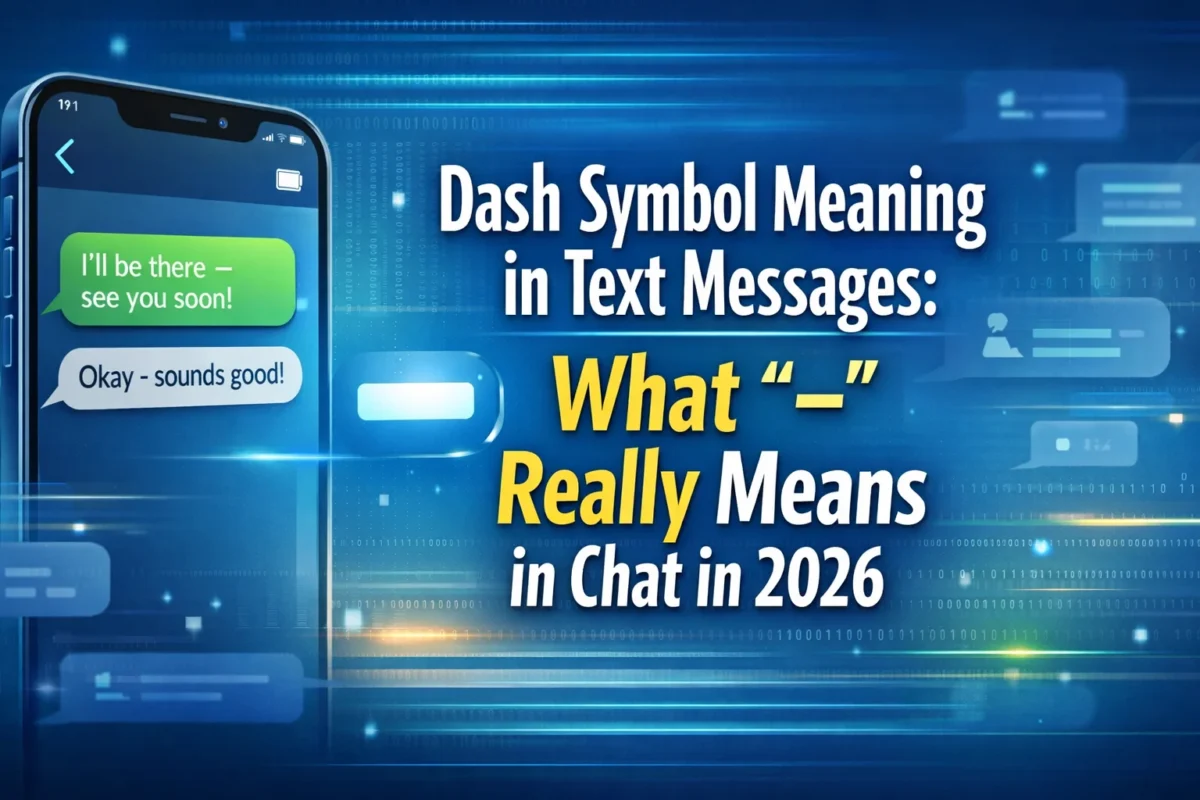
A tiny dash can create a surprisingly big misunderstanding in modern texting. You might send a simple “-” and think nothing of it. The other person? They might pause, reread it, and suddenly wonder if something feels off.That’s how digital communication works in 2026. Small symbols now carry emotional weight. Tone no longer depends only on words. It depends on punctuation, timing, and even silence.
The dash symbol meaning in text messages has evolved far beyond grammar rules. It no longer just connects words. Instead, it often signals hesitation, interruption, or subtle emotion that people don’t fully say out loud. In this guide, you’ll break down exactly what “-” means in chats, how people actually use it, and why context decides everything. You’ll also see real examples, platform differences, and psychological insights that explain why this tiny mark confuses so many people. Let’s decode it properly.
What the Dash Symbol Means in Text Messages in Simple Terms
In traditional writing, a dash connects ideas or adds emphasis. In texting, things get more flexible. People don’t follow strict grammar rules when they chat. They type fast. They react emotionally. They improvise.
So the dash symbol in text messages usually signals one of these things:
- A pause in thought
- A sudden shift in tone
- A cut-off sentence
- A soft or unfinished idea
- Casual punctuation instead of a full stop
Unlike formal writing, texting is emotional shorthand. The dash becomes a “feeling marker” rather than a grammar tool.
For example:
- “I think I- never mind”
- “Okay- I’ll do it”
- “We should talk- later maybe”
Each version feels slightly different, even though the words barely change.
That’s the key idea. The dash doesn’t just show structure. It shows mindset.
Most Common Meanings of Dash Symbol in Text Messages
The dash is small, but its meanings vary a lot depending on how someone uses it. Let’s break down the real-world interpretations.
Dash as a Pause or Hesitation
People often use “-” when they pause mid-thought. It mimics how we naturally speak.
In real life, you don’t talk in perfect sentences. You stop. You rethink. You adjust.
Texting copies that behavior.
Examples:
- “I was going to tell you- but it’s not important”
- “Maybe we should- actually forget it”
Here, the dash feels like a mental pause button.
It signals uncertainty, not completion.
Dash as a Soft Cut-Off or Reframe
Sometimes the dash shows a change of direction in thought. The sender starts a sentence, then quickly redirects.
Examples:
- “I thought you were- never mind”
- “We could go out tonight- or just stay in”
It acts like a verbal correction.
Think of it like someone speaking, stopping, and restarting with a better idea.
Dash as Emotional Restraint
This one is subtle but powerful.
People use the dash when they want to hold back emotion. It creates distance.
Examples:
- “I guess it’s fine-”
- “Do what you want-”
Notice how the tone feels colder or uncertain.
The dash replaces emotional clarity with hesitation.
Dash as Informal Punctuation Replacement
Many users don’t bother with commas or full stops anymore. They use a dash instead.
Examples:
- “Okay- I’m coming”
- “Sure- no problem”
This is purely stylistic. It keeps messages quick and casual.
It also reflects fast typing habits on mobile keyboards.
Why Context Changes Everything in Dash Symbol Meaning
The same dash can mean five different things depending on context.
Let’s break it down.
Position in the Sentence Matters
| Position | Example | Likely Meaning |
| End | “I guess so-” | hesitation or soft tone |
| Middle | “I was thinking- maybe not” | correction or shift |
| Beginning | “- I don’t know” | continuation or reaction |
Even a small shift changes emotional reading.
Relationship Between People Matters
The same dash means something different depending on who sends it.
- Friend → casual tone
- Partner → emotional hesitation
- Coworker → unclear professionalism
- Stranger → neutral or confusing
For example:
- Friend: “Okay- cool” (normal)
- Partner: “Okay-” (might feel distant)
Timing Between Messages Matters
Fast replies often make the dash feel casual. Delayed responses can make it feel emotional or tense.
A 5-second reply:
- “Okay- I’ll do it” → casual
A 2-hour gap:
- “Okay- I’ll do it” → may feel cold or reluctant
Same text. Different interpretation.
Dash vs Hyphen vs Em Dash in Texting
Most people don’t realize there are different types of dashes. In texting, they all blend together.
Here’s a simple breakdown:
| Symbol | Name | Typical Use | Texting Meaning |
| – | Hyphen | joins words | pause, casual break |
| – | En dash | ranges | rarely noticed in chats |
| — | Em dash | strong break | dramatic pause or emphasis |
In real texting, the simple hyphen “-” does most of the work.
Why?
Because it’s easy to type. One tap. No formatting.
People don’t care about grammar rules in fast conversations. They care about speed and tone.
Real Chat Examples and Their True Meaning
Let’s go deeper with real-world style conversations.
Casual Friend Chat Example
Message:
- “I think I’ll go gym- maybe later”
Meaning:
The person feels unsure. They’re not fully committed yet.
It’s a soft plan, not a promise.
Argument or Tense Situation Example
Message:
- “I didn’t say that- you misunderstood”
Meaning:
The dash shows correction under pressure.
It adds urgency and emotional defense.
Romantic Chat Example
Message:
- “I miss you- but I’m okay”
Meaning:
Mixed emotion. Affection combined with emotional control.
The dash softens the emotional weight.
Work Chat Example
Message:
- “I’ll send the report- by 5”
Meaning:
Casual professionalism. The dash replaces a comma or pause.
It keeps tone efficient but slightly informal.
Common Misunderstandings About Dash Symbol Meaning
People often misread the dash. Here are the biggest mistakes.
Assuming It Always Means Anger
This is the most common mistake.
A dash does NOT automatically mean anger.
It often means hesitation, not hostility.
Thinking It’s a Typo
Some people assume the sender forgot punctuation.
But in modern texting, the dash is intentional.
It carries tone.
Overthinking Every Dash
People sometimes read too deeply into it.
Not every dash hides emotion.
Sometimes it just fills space.
Ignoring Personal Writing Style
Everyone texts differently.
Some people naturally use dashes in every message. Others never do.
You must compare with their usual style.
Read More: FYM Meaning in Text (2026): What It Really Means and How to Use It
Platform Differences in Dash Usage
Where someone sends a message changes how the dash feels.
- Fast chats
- Informal tone
- Dash usually means nothing serious
Example:
- “Okay- coming”
SMS
- Slightly more formal
- Short messages
- Dash may feel more intentional
Instagram DMs
- Emotional tone
- Stylized messaging
- Dash may feel aesthetic or dramatic
iMessage
- More personal communication
- Subtle tone changes matter
- Dash may feel emotionally loaded
Psychology Behind the Dash Symbol
Why does a simple dash feel emotional at all?
It comes down to how the brain processes incomplete information.
When you see a dash, your brain tries to “fill the gap.”
It asks:
- Did they stop talking?
- Did they change their mind?
- Are they upset?
- Is something missing?
This creates mild uncertainty.
And uncertainty always feels emotional.
The dash becomes a trigger for interpretation, not just reading.
Modern Usage Trends in 2026
Texting habits have changed fast in recent years.
Here’s what’s happening now:
- People use fewer full sentences
- Emojis replace emotional punctuation
- Dashes act as soft tone markers
- Short messages dominate communication
- Speed matters more than grammar
Younger users especially use dashes as style tools.
Example:
- “okay- lol”
- “sure- whatever works”
It’s less about grammar and more about vibe.
Dash vs Similar Symbols in Texting
Let’s compare closely related symbols.
Dash vs Ellipsis
| Symbol | Meaning | Feeling |
| – | interruption or shift | sudden or uncertain |
| … | trailing thought | slow or emotional fade |
Example:
- “I guess I- never mind” (cut off)
- “I guess I…” (fade out)
Dash vs Emoji
- Emoji shows emotion clearly
- Dash hides emotion slightly
Example:
- “I’m fine 😊” → clear tone
- “I’m fine-” → uncertain tone
Case Studies: Real-Life Text Interpretations
Case Study 1: Misread Friend Message
A user receives:
- “I don’t care- do what you want”
They think the sender is angry.
But later they learn:
The sender uses dashes in every sentence habitually.
Lesson: style matters more than emotion.
Case Study 2: Romantic Misunderstanding
Message:
- “I miss you- but I need space”
Receiver feels rejected.
Actual meaning:
The sender feels emotional conflict, not rejection.
Lesson: dash often signals mixed emotion.
Case Study 3: Workplace Confusion
Message:
- “Send it- ASAP”
Employee thinks tone is rude.
But manager explains:
It’s just their shorthand style.
Lesson: professional texting often uses minimal punctuation.
How to Correctly Interpret Dash Symbol in Any Message
Follow this simple mental checklist:
- Look at full sentence meaning
- Check sender’s usual texting style
- Consider your relationship with them
- Review timing of message
- Don’t react instantly to punctuation alone
This helps you avoid unnecessary misunderstandings.
When You Should Ignore the Dash Completely
Not every dash deserves analysis.
Ignore it when:
- The conversation is fast-paced
- The sender uses it constantly
- The message is purely informational
- There is no emotional context
Sometimes, it’s just a typing habit.
FAQs:
What does a dash symbol mean in text messages?
A dash in texting usually shows a pause, hesitation, or sudden shift in thought. People also use it to soften a message or replace a comma in casual chats.
Does a dash mean someone is angry?
Not really. A dash can feel serious, but it doesn’t automatically signal anger. Most of the time, it reflects uncertainty, awkwardness, or a change in tone rather than emotion like anger.
Why do people end sentences with a dash?
People often end sentences with a dash when they want to sound less strict or more casual. It can also show they are unsure, trailing off, or leaving a thought incomplete on purpose.
Is a dash the same as an ellipsis (…) in texting?
No, they feel different. An ellipsis shows a slow fade or unfinished thought. A dash feels more like a sudden stop, interruption, or quick shift in direction.
Can a dash change the meaning of a message?
Yes, it can change tone a lot. For example, “I’m fine-” feels more uncertain than “I’m fine.” That small symbol can make a message sound softer, colder, or more hesitant.
Is using a dash in texting correct grammar?
In formal grammar, a dash has specific rules. But in texting, people use it loosely. It’s more about tone and style than following strict grammar rules.
Why do younger people use dashes more often?
Younger users often use dashes for quick communication and style. It helps them express tone without typing long sentences or using extra punctuation.
Does everyone interpret dashes the same way?
No, interpretation depends on context, relationship, and texting habits. One person might see it as neutral, while another might think it sounds distant or emotional.
Should I worry when someone uses a dash in their message?
Not usually. It’s better to look at the full conversation instead of focusing on one symbol. Most misunderstandings happen when people overthink small punctuation marks.
What is the safest way to understand a dash in chat?
Always check the full message, the sender’s tone, and past conversations. Context matters more than the dash itself, so avoid reading too much into it alone.
Conclusion:
A simple dash might look harmless, but it carries real emotional weight in modern communication.it shows hesitation, softness, correction, or sometimes nothing at all. The meaning depends on context, timing, and personality.So next time you see a “-” in a message, don’t rush to judge it. Read the full picture. Look at the sender’s style.
And remember, texting isn’t just words anymore. It’s tone, rhythm, and human behavior packed into tiny symbols.The dash doesn’t just end a thought. It often opens one.

Michael Johnson is the creative mind behind FunnyPuns.com, bringing laughter to everyday life with witty puns, clever jokes, and hilarious wordplay.

![120+ Best Halloween Jokes [2026 Trending Edition]](https://funnnypuns.com/wp-content/uploads/2026/04/best-halloween-jokes-768x432.webp)
![120+ Best Halloween Jokes [2026 Trending Edition]](https://funnnypuns.com/wp-content/uploads/2026/04/best-halloween-jokes-320x180.webp)
Leave a Comment