


Creators turning funny puns into social media visuals
Funny puns become more shareable when they are paired with the right visual format, layout, and audience context. A short joke can work as a caption, but the same idea can also become a social post, a sticker, a mug design, a short video hook, or a playful ad creative. That is why creators, small businesses, and content teams increasingly treat humor as a visual asset, not just a line of text.
The trick is not to make every pun louder. The trick is to make the joke easier to understand at a glance. A good visual gives the punchline a setting, a mood, and a reason to stop scrolling.
Why funny puns work so well in visual content
Puns are built for quick recognition. They usually depend on a familiar word, a small twist, and a tiny moment of surprise. That structure makes them useful for social platforms, where people decide in seconds whether to keep reading, save a post, or send it to a friend.
Visual content helps the pun land faster. For example, a coffee pun can become more memorable when it appears on a mug mockup. A book pun can work better when it sits beside a cover image. A pet pun becomes more charming when it is paired with a playful illustration or product preview.
This is also why puns are useful beyond entertainment. Restaurants, bookstores, creators, teachers, local shops, and ecommerce brands all use wordplay because it feels friendly. It lowers the pressure of a sales message and gives people something light to react to.
Start with one clear joke idea
The best visual content usually starts with one clear idea, not a long list of captions. Before designing anything, write the pun in its simplest form. Then ask what the audience is supposed to feel or do after seeing it.
If the goal is a quick laugh, the design can stay simple. If the goal is to promote a product, the visual needs space for the item. If the goal is to encourage sharing, the joke should feel relatable enough that people can imagine sending it to someone.
A useful test is this: would the pun still make sense if someone saw it for only two seconds? If not, the line may need to be shorter, or the visual may need to explain the context more clearly.
Match the pun to the right content format
Not every funny line belongs in the same format. A short one-liner may work well as a square Instagram graphic. A character-based pun may be better as a comic-style panel. A product pun may make more sense as a mockup on packaging, apparel, stationery, or a digital ad.
Here are a few practical matches:
- Food puns work well for restaurant posts, menus, packaging, and seasonal promos.
- Book puns fit bookmarks, launch graphics, book covers, reading campaigns, and classroom content.
- Pet puns are strong for stickers, social posts, merch, and friendly product ads.
- Work puns can become email banners, office posters, LinkedIn graphics, or team announcements.
- Holiday puns are useful for cards, sale graphics, gift guides, and limited-time campaigns.
This is where planning matters. A pun can be funny on its own, but a format makes it useful.
Build the visual around the punchline
Once the format is clear, the design should support the joke instead of competing with it. The punchline needs enough room to breathe. The background should match the topic. The image style should feel consistent with the audience.
For example, a playful pun for kids can use bright colors and friendly shapes. A pun for a business audience may need a cleaner layout. A pun for a product launch may need more realistic lighting, stronger spacing, and a clear product focus.
Creators who need fast concept images can use an AI image generator for creative teams to explore visual directions before choosing the final design. The value is not only speed. It helps teams test different moods, backgrounds, and compositions while keeping the main joke intact.
Turn one pun into a small campaign
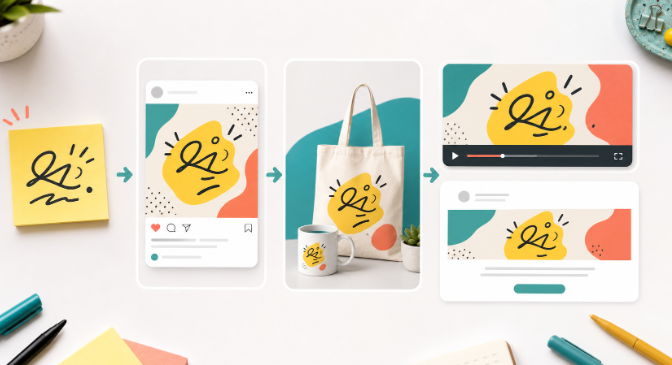
Funny caption idea becoming social posts, mockups, and campaign assets
A strong pun should not be used only once. If the idea is good, it can become a mini content set. Start with the main social post, then adapt it into related formats.
For example, a bakery might turn one bread pun into a square post, a menu card, a short video thumbnail, a sticker, and a tote bag preview. A bookstore might turn one reading pun into a launch graphic, bookmark mockup, email header, and shelf sign. A creator might turn one caption into a carousel, a story post, and a merch concept.
This makes the idea more efficient. Instead of starting from scratch every time, the creator builds a small system around one memorable line.
Use mockups to make the joke feel real
Mockups are especially useful when a pun is connected to a product or campaign. A joke on a blank page may feel like an idea. The same joke on a mug, shirt, poster, box, or book cover feels closer to something people can buy, share, or publish.
That is why mockups work well for humor-based campaigns. They show how the idea could live in the real world. A pun for a coffee shop looks more convincing on a cup. A pun for a pet brand feels more complete on packaging. A pun for a creator store becomes easier to judge when it appears on a shirt or sticker sheet.
For campaign planning, a mockup generator for product and campaign assets can help turn a funny line into realistic previews for review, testing, and presentation.
Keep the content helpful, not forced
Search-friendly guest posts should not feel like they were written only to place links. The article still needs to answer a real reader need. In this case, the reader wants to know how funny puns can become better posts, better designs, and better shareable ideas.
The safest approach is to keep the content practical. Explain the process. Give examples. Use natural language. Avoid repeating the same keyword again and again. If a tool is mentioned, it should appear where it genuinely helps the workflow.
Good visual content also needs basic quality checks. Before publishing, review the spelling, image clarity, spacing, brand colors, and readability on mobile. A pun loses impact if the text is too small or the design is too busy.
Simple checklist before publishing a pun-based visual
Before posting or sending a design for approval, check these points:
- Is the pun short enough to understand quickly?
- Does the visual make the joke clearer?
- Is the text readable on mobile?
- Does the image style match the audience?
- Can the same idea be reused in more than one format?
- Does the design avoid clutter around the punchline?
- If it is for a brand, does it match the brand tone?
These small checks can make the difference between a joke that gets ignored and one that people actually share.
Conclusion
Funny puns are more than quick laughs. With the right visual treatment, they can become social posts, product previews, email graphics, campaign assets, and small creative systems. The best results come from keeping the joke clear, choosing the right format, and building visuals that make the punchline easier to understand.
For creators and brands, the goal is not to make humor feel complicated. It is to give a good line the setting it deserves. When a pun is easy to read, easy to recognize, and easy to share, it has a much better chance of turning into content people remember.
FAQs
Can funny puns be used for marketing content?
Yes. Funny puns work well in marketing when they match the audience, product, and tone of the brand. They are especially useful for social posts, seasonal campaigns, local business promotions, and product mockups.
What makes a pun more shareable on social media?
A pun becomes more shareable when it is short, easy to understand, visually clear, and relatable. The best ones make people think of a friend, a hobby, a mood, or a familiar situation.
Should every pun be turned into an image?
No. Some puns work best as plain captions or comments. Turn a pun into an image when the visual setting makes the joke clearer, more memorable, or more useful for a campaign.
What type of images work best with puns?
Simple, topic-matched visuals usually work best. Product mockups, clean illustrations, social graphics, posters, stickers, and short video thumbnails can all support pun-based content.
How can small businesses use funny puns?
Small businesses can use puns in menus, signs, social posts, packaging previews, email banners, and seasonal promotions. The key is to keep the joke friendly and relevant to the product or service.

Pun enthusiast, wordplay wizard, and the mastermind behind Funnnypuns.com. David turns everyday language into laugh-out-loud moments—one pun at a time!


![120+ Best Broccoli Puns to Broc Your World [2026 Trending Edition]](https://funnnypuns.com/wp-content/uploads/2026/02/best-broccoli-puns-to-broc-your-world-440x248.webp)
![120+ Best Broccoli Puns to Broc Your World [2026 Trending Edition]](https://funnnypuns.com/wp-content/uploads/2026/02/best-broccoli-puns-to-broc-your-world-320x180.webp)

Leave a Comment