

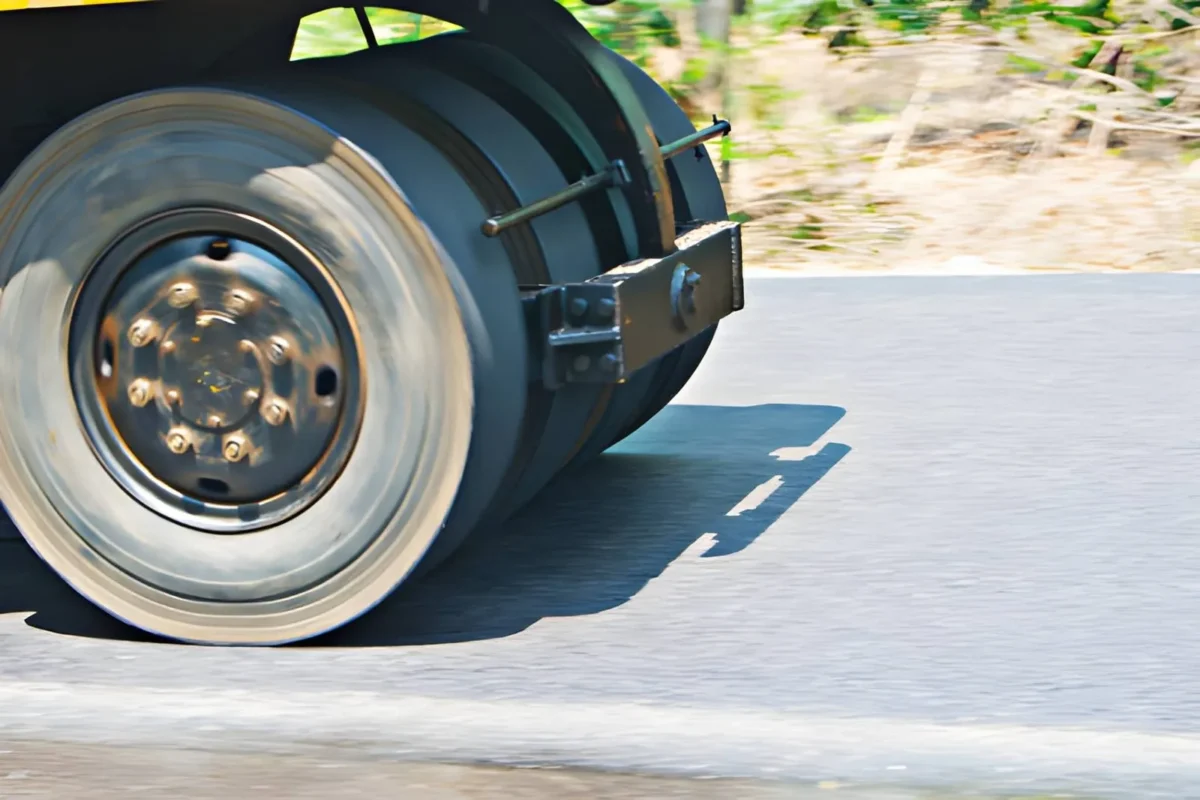
Whether you’re talking about a trailer hauling commercial goods or a personal camping trailer, it’s important to understand how the trailer’s length affects lane changes and turns. This is vital because trailers create off-tracking, enlarge blind spots, and magnify rotational leverage, which can lead to dangerous sway. When the driver understands these situations, they’ll be able to keep themselves and everyone else on the road safe. As a fellow driver sharing the roadway, this information will help you stay at a safe distance from long trailers.
How Trailer Length Affects Turns
Off-tracking happens when a trailer’s rear wheels take a different path from the front wheels while turning. How this affects the turn depends on how slow or fast the trailer is traveling.
At low speeds, like when making a tight right-angle turn, the rear wheels cut inside the path of the front ones. Since the rear trailer tires are tracking several feet closer to the inside curve, there’s a greater risk for riding over curbs, striking pedestrians on the sidewalk, or hitting traffic signs. To prevent this, the driver needs to swing the trailer wide before completing the turn, which often means going into the adjacent lane or off on the shoulder. This can trap cars that are waiting in the neighboring lanes.
When traveling at high speeds, centrifugal force can make the rear of the trailer drift outward relative to the tractor or vehicle’s path. This leads to a lack of control. The trailer may slide into adjacent traffic lanes, jackknife, cause a high-speed collision, or rollover. This is especially true if the driver overreacts or brakes too harshly.
Key factors that make off-tracking worse include the trailer length, the turn’s sharpness, and the axle and kingpin setup. For example, longer trailers and multi-trailer rigs increase the total off-tracking distance. Furthermore, sharp or narrow intersections force more extreme path differences. Also, a longer distance between the kingpin and the trailer’s rear axle group affects how sharply the trailer will cut inward.
A wider turning radius is another factor that influences how turning affects trailers. A wider turning radius means that the entire vehicle and trailer need more space and a broader arc to turn. The trailer can’t steer itself. Its movement relies on how the tow vehicle swings and how the wheels are off-track. To keep the trailer’s inside tires from hitting objects or running over curbs, the driver needs to steer wider or wait to start the turn. The rear corner of a long trailer will swing out in the opposite direction of the turn. This is the tail swing. A wider setup or longer rear overhang means the back corner can sweep across sidewalks, adjacent lanes, and parked cars. Towing a trailer will increase the necessary turning space by as much as 50% compared to the vehicle alone.
When a tail swing is combined with off-tracking, two danger zones are created. The front wheels cut inward while the back tail swings outward. Accidents can be prevented by hugging the outside of the vehicle’s current lane or by drifting slightly wide before the corner to set up a clean angle. The driver also needs to watch their mirrors carefully. They can’t focus solely on the truck’s bumper. They need to constantly monitor their trailer tires and side clearance throughout the turn. Controlling their speed is important as well. They should slow down to maintain control and let the trailer track smoothly behind to avoid jerking motions.
How Trailer Length Affects Lane Changes
Longer trailers change how a driver needs to make lane changes by increasing bling spots and multiplying leverage and sway forces. This makes it necessary to make much more gradual lane changes.
Longer trailers extend the vehicle’s total footprint far beyond the rear bumper. This leads to a massive bling spot zone along the sides and rear quarters. Standard side mirrors simply can’t cover these areas.
As the length of a trailer increases, the distance from the hitch pivot point acts as a longer lever arm. Any crosswind or steering input can make a longer trailer sway, whip, or drift much more aggressively than a shorter trailer. This means that the driver can’t quickly whip into a new lane. The longer setup requires the driver to make a long, smooth, diagonal drift instead. This gives the trailer enough time to track behind the tow vehicle without fishtailing. Since the total stopping distance and acceleration time increase, the driver will require a much larger traffic gap, both ahead and behind, to make a successful and safe lane change.
When towing a longer trailer, drivers need to use towing mirrors and take advantage of blind zone tech, such as blind zone alerts. They have to ensure extended towing mirrors are properly adjusted before hitting the road, and they must signal early when changing lanes. The blinker should be turned on well in advance to provide the surrounding drivers with enough time to react to the extended trailer length. Lane changes should be slow and deliberate. The driver should avoid jerky or sharp wheel movements that amplify pivot forces and cause the trailer to sway. They should not pull back into their original lane without confirming complete clearance.
When both the driver and others on the road understand how trailer length affects turns and lane changes, they can avoid accidents. That being said, there will always be those unavoidable situations where a mishap occurs. Fortunately, the services of an experienced truck accident lawyer like those at Frost Law Firm, PC can offer assistance after a collision.

Pun enthusiast, wordplay wizard, and the mastermind behind Funnnypuns.com. David turns everyday language into laugh-out-loud moments—one pun at a time!


![120+ Best Funny Jazz Puns [2026 Trending Edition]](https://funnnypuns.com/wp-content/uploads/2026/03/best-funny-jazz-puns-768x432.webp)
![120+ Best Funny Jazz Puns [2026 Trending Edition]](https://funnnypuns.com/wp-content/uploads/2026/03/best-funny-jazz-puns-320x180.webp)
Leave a Comment