

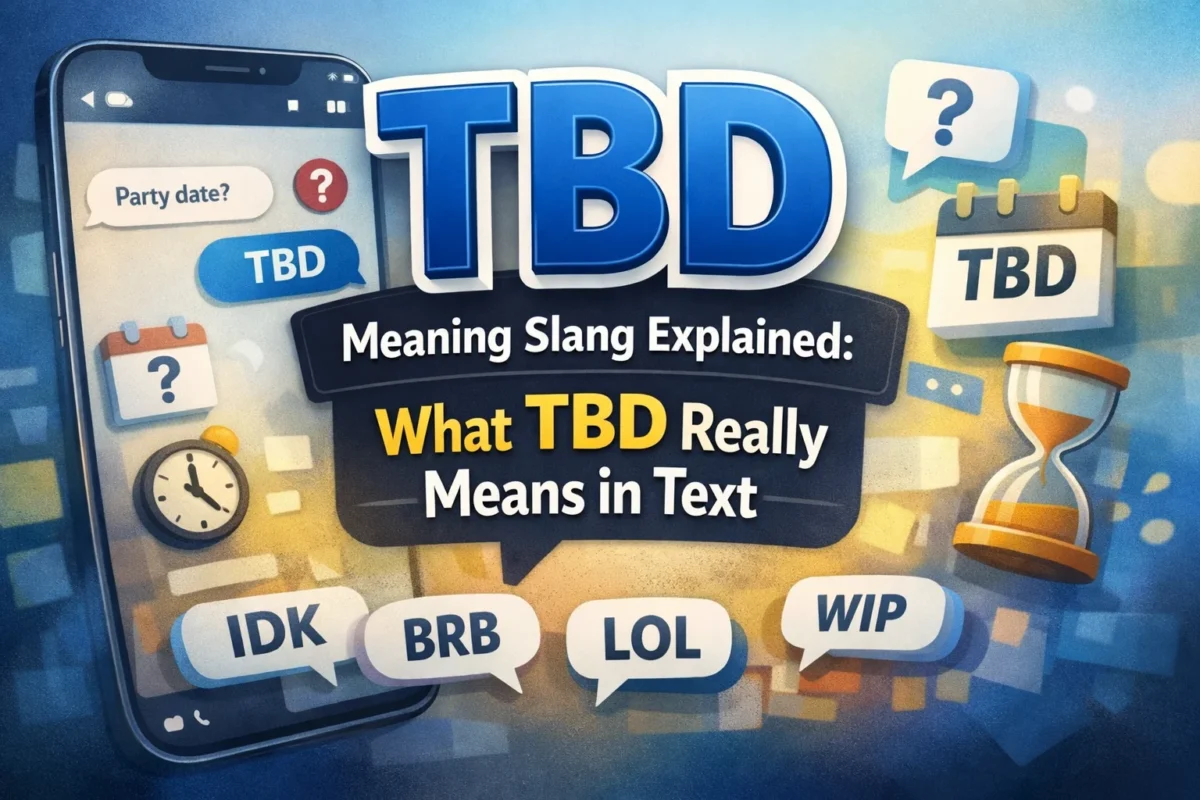
In TBD Meaning Slang, when You’ve probably seen TBD in a message, email, event, or post, you may have paused for a second, wondering what it actually means in today’s fast-moving digital world.
This slang acronym is often tied to planning, scheduling, and decision-making, helping people understand plans and deadlines while reducing confusion, yet many still pause, think, and expect clearer signals in both casual and professional contexts.
What Does TBD Mean in Slang and Text?
At its core, TBD stands for “To Be Determined.”
Simple, right? But the meaning goes deeper depending on context.
The Real Meaning Behind TBD
When someone uses TBD, they’re saying:
- A decision hasn’t been made yet
- Details are still pending
- More information is needed before confirming
Think of it as a placeholder. A temporary label that signals, “We’ll figure this out soon.”
Quick Examples
- “Meeting time: TBD”
- “Location is TBD, I’ll update later”
- “Final guest list: TBD”
Each one tells you the same thing: something is undecided but expected to be finalized soon.
TBD Meaning in Text and Chat Conversations
In texting and online chats, TBD takes on a slightly different tone. It feels lighter. Less formal. Sometimes even a bit vague.
You’ll often see it in:
- Group chats
- Event planning messages
- Casual conversations
How People Use TBD in Real Chats
Here’s how it naturally shows up:
- “We’re going out this weekend, time TBD”
- “Movie night—location TBD”
- “I’ll join, but my schedule is TBD”
Notice something? The tone isn’t rigid. It’s flexible. Open-ended.
What the Sender Actually Means
Depending on the situation, TBD can signal different things:
- Genuine uncertainty → They truly don’t know yet
- Waiting on others → They need confirmation first
- Soft commitment → They’re not fully sure they’ll follow through
That last one matters. In casual chats, TBD can sometimes act as a polite delay tactic.
Mini Case Study: Group Chat Planning
Imagine this:
“Dinner on Friday? Time TBD.”
At first glance, it seems harmless. But here’s how people interpret it:
| Person | Interpretation |
| Organizer | “We’ll finalize details soon” |
| Friend A | “I’ll wait before making plans” |
| Friend B | “This might not even happen” |
Same message. Different assumptions.
That’s the hidden power—and risk—of using TBD in text.
TBD Meaning in Work and Professional Communication
Now shift to a professional setting. Suddenly, TBD carries more weight.
In business communication, clarity matters. Deadlines matter. Precision matters.
Yet, you’ll still see TBD everywhere:
- Project timelines
- Business reports
- Meeting agendas
- Product roadmaps
Why Professionals Use TBD
It serves a clear purpose:
- Keeps documents flexible during early planning
- Signals incomplete but evolving information
- Allows teams to move forward without full details
In fast-paced environments, waiting for perfection slows everything down. TBD keeps momentum alive.
Real Professional Examples
- “Project deadline: TBD”
- “Final approval: TBD”
- “Budget allocation: TBD”
Each one highlights uncertainty—but also progress.
When TBD Works Well at Work
Use it when:
- You’re in the early stages of planning
- External factors influence decisions
- Teams are still gathering data
When TBD Becomes a Problem
Overuse creates issues. Fast.
Avoid it when:
- Final decisions are expected
- Stakeholders need clarity
- It appears repeatedly without updates
Too many TBDs in a document send a subtle message:
“We’re not fully prepared.”
Case Study: Project Planning Breakdown
A marketing team creates a campaign brief:
- Launch date: TBD
- Budget: TBD
- Target audience: TBD
Result?
- Team confusion
- Delayed execution
- Frustrated stakeholders
Lesson: TBD works best in moderation.
Read More: FYI Meaning in Text | What FYI Really Means & How to Use It
TBD vs TBA vs Other Slang Terms
People often confuse TBD with similar abbreviations. That confusion leads to miscommunication.
Let’s clear it up.
Key Differences Table
| Term | Full Form | Meaning | Key Insight |
| TBD | To Be Determined | Not decided yet | Decision still pending |
| TBA | To Be Announced | Already decided, not shared | Info exists but hidden |
| TBH | To Be Honest | Expressing honesty | Not related to planning |
| IDK | I Don’t Know | Lack of knowledge | More casual and direct |
TBD vs TBA (The Big Confusion)
Here’s the simplest way to remember:
- TBD = Decision not made yet
- TBA = Decision made, not revealed
Example
- “Speaker: TBD” → We haven’t chosen yet
- “Speaker: TBA” → We’ve chosen, but we’ll announce later
That difference can change expectations instantly.
When Should You Use TBD? (Best Practices)
Using TBD effectively isn’t about knowing what it means. It’s about knowing when it fits.
Ideal Situations for Using TBD
You should use it when:
- Planning events or schedules
- Drafting early-stage documents
- Waiting for external confirmation
- Coordinating with multiple people
Best Practices for Clear Communication
Follow these simple rules:
- Use it temporarily → Don’t leave it unresolved
- Provide context → Explain why it’s TBD
- Update quickly → Replace it with final details ASAP
- Limit usage → Avoid stacking multiple TBDs
Example of Good Usage
“Meeting time is TBD. Waiting for client confirmation.”
Clear. Informative. No confusion.
When NOT to Use TBD
Sometimes, TBD does more harm than good.
Avoid Using TBD When
- You’re delivering final reports
- You need to sound authoritative
- It creates unnecessary ambiguity
- You already have the information
Why Overusing TBD Hurts You
- Reduces credibility
- Signals poor planning
- Frustrates readers
Better Alternatives to TBD
Instead of defaulting to TBD, try:
- “Pending confirmation”
- “To be finalized”
- “Awaiting approval”
- “Details coming soon”
These phrases feel more intentional. More precise.
Is TBD Formal or Informal?
The answer? It depends on how you use it.
In Casual Contexts
- Feels relaxed and flexible
- Common in texts and chats
- Carries little pressure
In Professional Contexts
- Acceptable but controlled
- Works in drafts, not final versions
- Requires timely updates
Quick Comparison
| Context | Tone | Acceptability |
| Texting | Casual | High |
| Social media | Informal | High |
| Work drafts | Semi-formal | Medium |
| Final reports | Formal | Low |
Common Misunderstandings About TBD Meaning
Even though it’s simple, people still misuse TBD.
Misconception 1: TBD Means “Unknown Forever”
Wrong.
It means temporary uncertainty, not permanent confusion.
Misconception 2: TBD = TBA
As explained earlier, they’re not the same.
This mix-up can mislead readers.
Misconception 3: Using TBD Saves Time
Not always.
Sometimes, it delays clarity instead of improving efficiency.
Real-Life Use Cases of TBD Meaning
Let’s bring this into real life.
Event Planning
- “Venue: TBD”
- “Guest list: TBD”
Used to keep planning flexible.
Business Strategy
- “Marketing approach: TBD”
- “Launch timeline: TBD”
Common during brainstorming phases.
Personal Life
- “Dinner plans: TBD”
- “Weekend trip: TBD”
Keeps things open without commitment.
Freelancing & Remote Work
- “Payment schedule: TBD”
- “Project scope: TBD”
Used during negotiation stages.
Quick Summary: What TBD Really Means
Let’s wrap up the essentials:
- TBD means “To Be Determined”
- It signals that something is not yet decided
- It works in both text and professional communication
- Overuse can lead to confusion
- It should always be temporary, not permanent
FAQs About TBD Meaning in Text and Work
What does TBD mean in texting?
It means “To Be Determined,” showing that details aren’t decided yet.
Is TBD professional to use in emails?
Yes, but only in drafts or early stages. Avoid it in final communication.
What’s the difference between TBD and TBA?
TBD means not decided yet. TBA means decided but not announced.
Can TBD mean “I don’t know”?
Sometimes, yes. In casual chats, it can imply uncertainty.
Is TBD rude or unclear?
Not rude, but it can feel vague if overused.
When should I avoid using TBD?
Avoid it in final reports or when clarity is critical.
Does TBD mean something is already planned?
Not necessarily. It usually means planning is still ongoing.
How long should something stay TBD?
As short as possible. Replace it once details are confirmed.
What are better alternatives to TBD?
Use phrases like “pending confirmation” or “to be finalized.”
Why do companies use TBD so often?
It allows flexibility during planning and decision-making stages.
Conclusion:
“TBD” might look small, but it carries weight.
Use it wisely, and it keeps communication flexible. Overuse it, and it creates confusion. That balance matters.
Here’s the bottom line:
- Be clear about why something is TBD
- Update it quickly
- Avoid hiding behind it
Think of TBD as a temporary placeholder—not a permanent excuse.
Use it with intention, and your communication instantly becomes sharper, clearer, and more professional.

Michael Johnson is the creative mind behind FunnyPuns.com, bringing laughter to everyday life with witty puns, clever jokes, and hilarious wordplay.


![120+ Best Valentines Day Heart Puns [2026 Trending & Top Picks]](https://funnnypuns.com/wp-content/uploads/2025/12/best-valentines-day-heart-puns-440x248.webp)
![120+ Best Valentines Day Heart Puns [2026 Trending & Top Picks]](https://funnnypuns.com/wp-content/uploads/2025/12/best-valentines-day-heart-puns-320x180.webp)
![120+ Best [Cake Puns] [2026 Trending Edition]](https://funnnypuns.com/wp-content/uploads/2026/01/cake-puns-768x432.webp)
![120+ Best [Cake Puns] [2026 Trending Edition]](https://funnnypuns.com/wp-content/uploads/2026/01/cake-puns-320x180.webp)
Leave a Comment